The "Hard-to-Keyword"

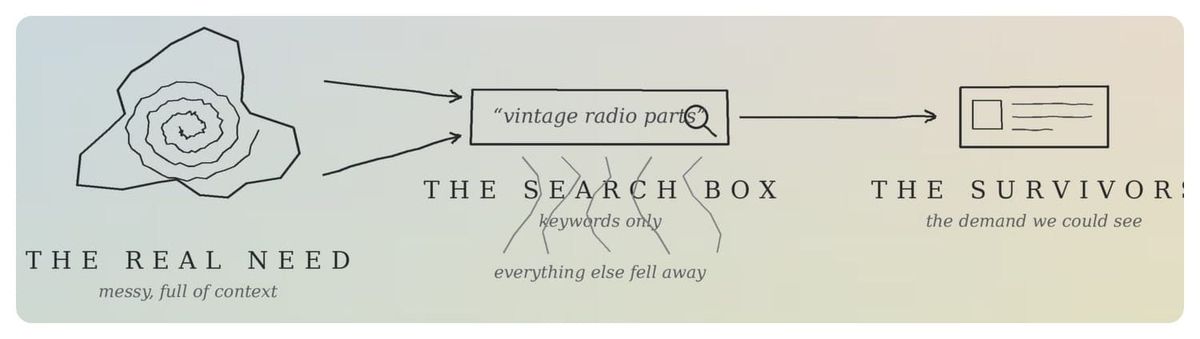
Typed search queries are survivors. Twenty years of e-commerce trained buyers to shrink what they wanted into whatever the product index could match, and the rest never reached the logs.
Try typing this into the search box of any shopping site:
"a gift for my dad who restores old radios but claims he has everything"
You won't. You already know how it ends. So you type "vintage radio parts," you get a wall of listings that miss the point, and you close the tab. Maybe you buy a gift card. Maybe you buy nothing and feel vaguely bad about it in December.
The gap between what you wanted and what you typed is the thing I have been stuck on for the last year. I have started calling it Hard-to-Keyword demand.
What is Hard-to-Keyword demand?
Hard-to-Keyword demand is real purchase intent that never becomes a search query, because the buyer cannot compress it into words the catalog would recognize.
It usually gets labeled low intent. Often it is the opposite. Some of the most motivated shopping a person does all year is Hard-to-Keyword. Gifts. Replacements for something that broke whose name you never learned. Purchases with a constraint stapled to them: something that works in a rental, something my mother in law won't hate, something that isn't the one everyone already has.
The intent is high. The vocabulary is missing.
Why did buyers learn to type less than they meant?
Because the search box punished them for typing more.
Early product search was lexical. It matched words in your query against words in a listing title. Every extra word you added was another chance to match nothing. Twelve words returned zero results. Two words returned ten thousand. Shoppers ran that experiment a few times each and drew the obvious conclusion.
So we all learned the dialect. Noun, modifier, maybe a brand. "Vintage radio parts." "Black midi dress." "Lawn mower blade." That is not how anyone describes what they want to a person. It is how you describe what you want to an index.
Then the whole industry optimized around the dialect. Merchants wrote titles stuffed with the two-word phrases that converted. SEO teams built pages for head and mid-tail terms. Category taxonomies got assembled out of the words people typed, which were already a lossy compression of the words people meant. Each layer trained the next one on the same shrunken vocabulary.
Twenty years of that. We did not just fail to serve Hard-to-Keyword demand. We taught buyers not to express it.
Typed queries are survivors
Here is the part I think about most, and it comes from five years at Google Shopping and the current stretch at eBay working on agentic commerce.
We measured demand by what people typed.
But typed queries are survivors. They are the intentions that made it through the compression step intact. The ones that could not compress never reached the logs at all. They did not appear as zero-result queries. They did not appear as abandoned sessions. They appeared as nothing, because the shopper skipped the search box entirely and asked a friend, or walked into a store, or gave up quietly and stopped trying.
This is a survivorship problem, and it is the uncomfortable kind. The data does not tell you it is incomplete. Query logs look magnificent. Millions of rows, clean distributions, a long tail satisfying enough to build a whole strategy on. Nothing in that file announces itself as a sample.
We optimized for the demand we could see and called the rest low intent.
What is actually changing with AI shopping
The common version of this story is that queries got longer. That is true and it is the least interesting part.
What looks different to me is the shape of the shopping trip.
People compare along dimensions the old box never allowed, the ones that live in adjectives and constraints rather than filters. They ask the follow-up instead of guessing. They correct the system mid-conversation instead of reformulating a query and starting over. They arrive at the decision with more of the reasoning already done, which shows up as fewer sessions and more confidence rather than more sessions and more clicks.
Notice that none of those are search improvements. They are behavior changes. The search box did not get smarter so much as it stopped being the thing you had to negotiate with.
The question I cannot answer yet
Two explanations fit everything above, and they lead to completely different places.
Expansion. AI is surfacing demand that was never in the funnel. The buyer who gave up in 2014 and quietly stopped trying is back. Total addressable market grows.
Substitution. The demand was always being met, just not anywhere we measured. It went to a friend's recommendation, a subreddit, a store associate, a niche forum. Now it moves to an AI surface we finally have instrumentation for. Measured demand grows. Actual demand does not.
The industry is currently reporting substitution numbers and calling them expansion. That is an easy mistake to make and an expensive one, because the two scenarios justify very different investment.
I do not know which one is true. I think it is partly both, and I think the mix varies enormously by category. But I have not seen anyone make a serious empirical case either way, and I would like to.
How would you actually tell the difference?
This is where it gets hard, and where I think the interesting work is.
Look at category mix, not volume. If AI-assisted purchases skew toward categories with a high specification burden (parts, compatibility-constrained goods, gifts, fit-dependent items), that is a signal the new surface is doing work the old box genuinely could not. If the mix mirrors overall e-commerce, it is more likely a channel shift wearing a costume.
Measure at the person level, across a year. Session-level metrics cannot distinguish expansion from substitution, because both look like a good session. Does an individual buyer purchase in more distinct categories than they did before? Does purchase incidence rise, or just channel share?
Instrument the give-up. We track conversion obsessively and abandonment loosely. Almost nobody tracks the intention that never became a session. The only way to see it is to ask people directly, which brings me to the last one.
Ask the counterfactual. Where would this purchase have gone otherwise? A shopper who says "I would have searched Google" is substitution. A shopper who says "I would have asked my brother in law" or "I would not have bought anything" is something else. This requires panel research, not analytics.
That last point generalizes into the line I keep coming back to:
You cannot answer a survivorship question with the surviving data.
The logs cannot tell you what the logs never captured. Every measurement instrument we built over the last twenty years was built downstream of the compression step. To see Hard-to-Keyword demand, you have to go ask humans what they wanted and could not say.
I am planning to run that study. More on it when I have something worth showing.
What to do while the question is open
You do not need the answer to act on the premise. A few things I would do regardless of which way it breaks:
Stop treating vague queries as low intent in your reporting. Vagueness has been a proxy for "our system cannot handle this," not for "this person is not serious." Those got conflated a long time ago and the conflation is now load-bearing in a lot of dashboards.
Write listings for constraints, not keywords. Product copy optimized for lexical matching is optimized for the old compression. Fit, compatibility, occasion, use case, and what it is not good for are the details an agent can actually reason over. This is the same shift that GEO is describing on the content side, arriving in the catalog.
Assume the retrievable unit is changing. For twenty years the unit was the keyword page. It is becoming the answered question. That has real implications for how you structure a catalog, a help center, and a content program.
Go find your own Hard-to-Keyword queries. Sit with five customers and ask what they wanted to buy last year and could not describe. It takes an afternoon. I have not once done this without hearing something that was not in any query log I had access to.
The part I keep coming back to
The prize here is not a smoother search experience. Smoother search is a margin story.
The prize is a bigger market. Every need too Hard-to-Keyword was a customer we never counted, a purchase that never happened, and a gap that never showed up as a gap because the measurement system and the failure had the same blind spot.
I would like to know how big that number is. I suspect it is larger than anyone has guessed, mostly because nobody has been in a position to guess.
So, a question I have been asking everyone. What is something you wanted to buy and could never put into words?
Mine: matching Nikes that are cool to wear with my wife on vacation.
Twenty years of search, and I still have not found them.
Eric Cheung is a Product Manager for Agentic Commerce at eBay. He spent five years at Google Workspace and Google Shopping before that. He writes about e-commerce search, AI, and how buying behavior actually works at sayeric.com. Views are his own.
